
Continuous Generation, Inference Loops, and the Return of Real Grounding
What Runway’s Solaris and fal’s continuous filmmaking imply for enterprise AI data infrastructure
Abstract
Continuous generative systems are collapsing the cost of producing interactive media and long-form film-like output through real-time world models and agentic inference loops. At the same time, demand for trustworthy grounding—context, provenance and persistent identity—continues to rise, especially for robotics, enterprise workflows and embodied systems. This short research note argues that continuous generation does not retire the need for real-world data infrastructure; it intensifies it. We examine Interface World Models and continuous filmmaking as industry markers of the shift, show why synthetic volume alone is incomplete, and outline a provenance-first reference architecture realized in Harbor Passport and its surrounding capture–validate–deliver stack.
1. The Shift Underway
For several product cycles, generative video meant clips: a prompt in, a few seconds out, then a human editor stitching fragments into something longer. That framing is ending. Two industry moves in 2025–2026 make the break explicit.
First, Interface World Models such as Runway’s Solaris generate software interfaces frame by frame as the user interacts, with no intermediate HTML, CSS or JavaScript representation. Rendering and interaction are joint; the session is continuous rather than a sequence of static screens. Runway positions Solaris not only as a new medium for apps and storefronts, but as a way to train agents against interfaces that keep changing.
Second, continuous filmmaking on inference platforms such as fal turns multi-step creative production into an agent session: storyboard, lock character references, animate, grade, score—each step another model call, each call another unit of spend. Project memory, skill templates and budget controls turn “generate a clip” into “run a production loop until delivery.” Continuity is no longer an editorial afterthought; it is an economic loop over inference.
Together these systems redefine the scarce resource. Generating more pixels is increasingly a matter of how long the loop is allowed to run. What remains scarce is high-signal, trustworthy data—assets whose origin, consent, rights and operational context can be defended when models move from demos into production. As we argued in From Models to Reality, competitive advantage is migrating toward data infrastructure that carries rich context, verifiable provenance and persistent contributor identity. Continuous generation sharpens that claim rather than softening it.
2. Why Continuity Is Not Enough
Most discussion of these systems still measures progress by length of session, visual fidelity or cost per generated second. Those metrics are useful and incomplete. Two corpora of similar duration—one continuous synthetic, one lightly instrumented real video—can differ sharply in usable training signal once downstream requirements are taken into account.
Continuous generation fails compoundedly. Small inconsistencies in identity, lighting, layout or physics that are tolerable in a five-second clip become structural faults across a long session or multi-scene campaign. When every frame looks finished, false product claims, invented UI affordances and physically implausible recoveries are harder to spot. Runway itself notes that a convincing wrong answer is worse than no answer, and that richer verified context remains an active research focus. Continuous film loops mix starting frames, brand plates, prior outputs, third-party models and human edits; without chain-of-custody, enterprises cannot answer where an asset came from, who consented, whether it was modified, or what licenses govern reuse.
The same scarcity appears on the evaluation side. Training computer-use agents inside generated interfaces expands coverage, but does not replace held-out evaluation on real commercial workflows. Academic and industrial benchmarks for multi-step, economically grounded tasks continue to show a wide gap between short-horizon recognition scores and reliable long-horizon performance when physical or operational grounding is required. Field patterns are consistent with earlier egocentric results: models that look strong on frame-level or short-horizon recognition often drop sharply on long-horizon and exception-recovery work unless the corpus is enriched with structured context and provenance.
3. Context, Provenance and Persistent Identity
Three properties turn continuous media—synthetic or real—into usable enterprise assets.
Context is the metadata that situates an observation or generation: skill level of the performer, environmental state, device calibration, task intent, safety regime, and, for synthetic loops, which references and models conditioned the session. Two streams can look nearly identical while carrying very different informational content. Context recorded at capture or generation time is information that cannot be reliably reconstructed later.
Provenance answers the questions every enterprise buyer eventually asks: where did this come from, under what conditions, who collected or generated it, has it been modified, and what rights govern its use. A complete chain—from contributor or model through timestamp, validation and delivery—supports auditability, filtering after the fact, and regulatory documentation. Without it, a continuous corpus is an anonymous bag of frames whose quality and legality cannot be defended under scrutiny.
Persistent contributor identity (with consent and governance) enables longitudinal quality tracking, coherent preference signals, detection of individual-level distribution shift, and adaptive matching of validators to domain and contributor history. Continuous pixels are not a substitute for continuity of people. Harbor Passport is one concrete realization of this primitive: it binds consent, longitudinal history and capture integrity to every asset so that enterprise trust travels with the data.
4. A Provenance-First Architecture
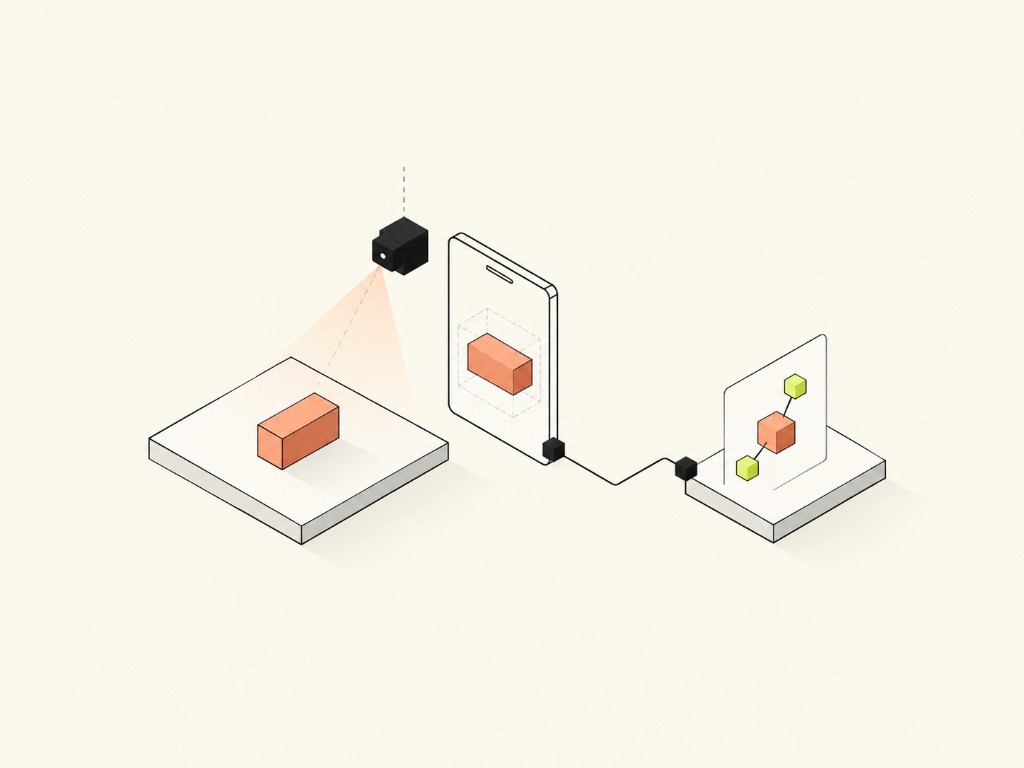
A practical architecture treats these properties as first-class rather than optional post-processing, and treats continuous generative systems as one half of a closed loop whose other half is governance-grade real capture and validation:
- Capture — consented, continuous multimodal streams in real commercial environments (warehouse, trades, logistics, clinical, residential), including egocentric viewpoints that embodied and agentic systems need.
- Harbor Passport — persistent identity that binds consent, longitudinal history and capture integrity to every asset.
- Adaptive validation — domain-matched specialists applying operational rubrics rather than generic labeling pools—especially important when synthetic outputs must be graded for “convincing wrong” failure modes.
- Enterprise delivery — structured manifests, quality scores and full audit trails ready for foundation-model pipelines, eval harnesses and hybrid training mixes.
The design choice is deliberate. Context, identity and provenance are not reconstructed weeks later by a labeling pool; they are captured and preserved so that downstream teams can filter, re-weight or exclude assets without reverse-engineering the collection process. Session memory inside a creative agent is useful and not the same as a cross-vendor, audit-ready chain from real contributor through device, validation and delivery.
5. Counterarguments and Domain Dependence
Synthetic data, Interface World Models and continuous filmmaking have improved coverage, iteration speed and visual coherence. They still struggle with the long tail of real material interactions, lighting extremes, tool wear, skilled human recovery strategies and rights-bound commercial context. Hybrid pipelines that combine synthetic scale with real, provenance-rich anchors continue to outperform pure synthetic regimes on most transfer benchmarks.
Reinforcement learning and agent training in generated interfaces can refine behaviour and expand interaction diversity, but still depend on high-quality initial demonstrations or preference data—especially in sparse-reward physical domains. Preference data itself is more coherent when grounded in persistent expert identity over time.
Context is not universally useful; in some pure language or static-image settings it can introduce noise. In continuous, long-horizon and operational settings its value is typically higher and more consistent. The correct posture is empirical: instrument the pipeline so the contribution of each class of context can be measured against the metrics that matter.
Implementation cost is likewise domain-dependent. For low-stakes creative prototypes the overhead of full provenance may be hard to amortize. For enterprise, regulated or production robotics pipelines the cost of missing provenance—retraining after contamination, legal exposure, loss of buyer confidence—is frequently higher than the cost of building the chain correctly from the start. As continuous loops accelerate production, that cost rises with them.
6. Implications for Teams Buying or Evaluating Data
Volume and session length should be paired with explicit requirements for context fields, provenance completeness and identity governance. Treat continuous film and Interface World Model outputs as provisional until grounding requirements are explicit.
Held-out evaluation sets should stress long-horizon recovery, skill differentiation and operational exception handling rather than only short-horizon recognition or aesthetic preference. Agents trained in generated interfaces should be stress-tested on real commercial workflows before deployment claims are made.
Vendor comparisons should include the ability to audit and filter delivered assets after the fact—on synthetic and real assets alike. A lower unit cost of inference that cannot be traced often proves more expensive once contamination, rights disputes or silent quality drift appear.
In environments where models must act in the physical world or under enterprise trust constraints, the difference between a large continuous synthetic corpus and a somewhat smaller but fully contextualized, fully provenance-tracked corpus is frequently the difference between a model that looks strong on paper and a model that is reliable in deployment.
7. Conclusion
If continuous generation keeps getting cheaper, longer and more autonomous, durable advantage will migrate toward the infrastructure that supplies high-quality, verifiable, context-aware representations of the real world. Persistent contributor identity, rich contextual metadata and verifiable provenance are architectural primitives, not optional annotations. Organizations that treat them as first-class infrastructure—alongside continuous synthetic systems—will be better positioned to convert real human experience into reliable model behaviour.
Harbor’s contribution is one practical realization of that principle: an operational system for capturing, validating and delivering egocentric enterprise intelligence while preserving the full chain of context, identity and provenance that modern training, evaluation and deployment regimes increasingly require.
Continuous generation expands what machines can show. Provenance-rich real capture determines what enterprises can rely on.
References
[1] Runway. Introducing Solaris: Interface World Models. August 31, 2026. https://runwayml.com/news/research/introducing-solaris
[2] fal. fal Agent — creative partner across image, video and 3D models (session memory, skills, enterprise provenance and budget controls). https://fal.ai/agent
[3] Harbor Research. From Models to Reality: Why Context, Provenance and Persistent Identity May Define the Next Generation of AI Infrastructure. August 2026. https://harborml.com/research/from-models-to-reality
[4] Grauman et al. Ego4D: Around the World in 3,600 Hours of Egocentric Video. CVPR / TPAMI extended, 2022–2025. https://arxiv.org/abs/2110.07058
[5] Grauman et al. Ego-Exo4D: Understanding Skilled Human Activity from First- and Third-Person Perspectives. 2023–2024. https://arxiv.org/abs/2311.18259
[6] Data Provenance Initiative and related audits of training-data lineage, licensing and documentation gaps. 2024–2026. https://www.dataprovenance.org
[7] Harbor technical documentation and operational metrics (contributor network, Passport, adaptive validation, enterprise delivery). harborml.com, 2025–2026.
[8] Surveys and lineage of egocentric datasets for physical AI and robotics (EPIC-KITCHENS, EgoDex, EgoVerse, MobileEgo, HOT3D). 2018–2026.
[9] Industry and academic reports on sim-to-real gaps and the continuing value of real demonstration data alongside synthetic scale. 2023–2026.
[10] Human-to-robot transfer studies showing substantial gains from high-quality egocentric demonstrations (various 2024–2026).