
From Models to Reality
Why Context, Provenance and Persistent Identity May Define the Next Generation of AI Infrastructure

Harbor Research
Harbor Research
Open-weight models, falling inference costs and synthetic data are making many model capabilities more widely available. At the same time, demand for real-world, domain-specific data continues to rise—especially for robotics, enterprise workflows and embodied systems. This short research note argues that competitive advantage is shifting toward data infrastructure that carries rich context, verifiable provenance and persistent contributor identity. We examine these properties as architectural primitives rather than product features, illustrate their impact with current egocentric dataset trends and performance gaps, and outline a provenance-first reference architecture realized in Harbor Passport and its surrounding capture–validate–deliver stack.
The Shift Underway
Robotics and enterprise AI are entering a phase where capable hardware and reusable baseline models make it possible to prototype systems in factories, warehouses, homes and vehicles that previously could not justify the cost of building perception and control from scratch. The bottleneck is moving. Model scale and proprietary training runs still matter, but they are no longer the only scarce resource. What is becoming scarce is high-signal, trustworthy data from the exact environments where systems will operate.
Egocentric (first-person) multimodal data—synchronized video, spatial audio and sensor streams—sits at the center of this shift. Unlike third-person or web-scraped corpora, it captures the viewpoint, hand–object interactions and long-horizon structure that physical systems must understand. Recent collections have grown dramatically in scale, from the several thousand hours of Ego4D to industrial releases measured in tens or hundreds of thousands of hours. Yet scale alone does not solve the deeper problems of context, identity and chain-of-custody that enterprise and production teams now face. The distinction between research-scale diversity and enterprise-grade governance is becoming sharper every quarter.
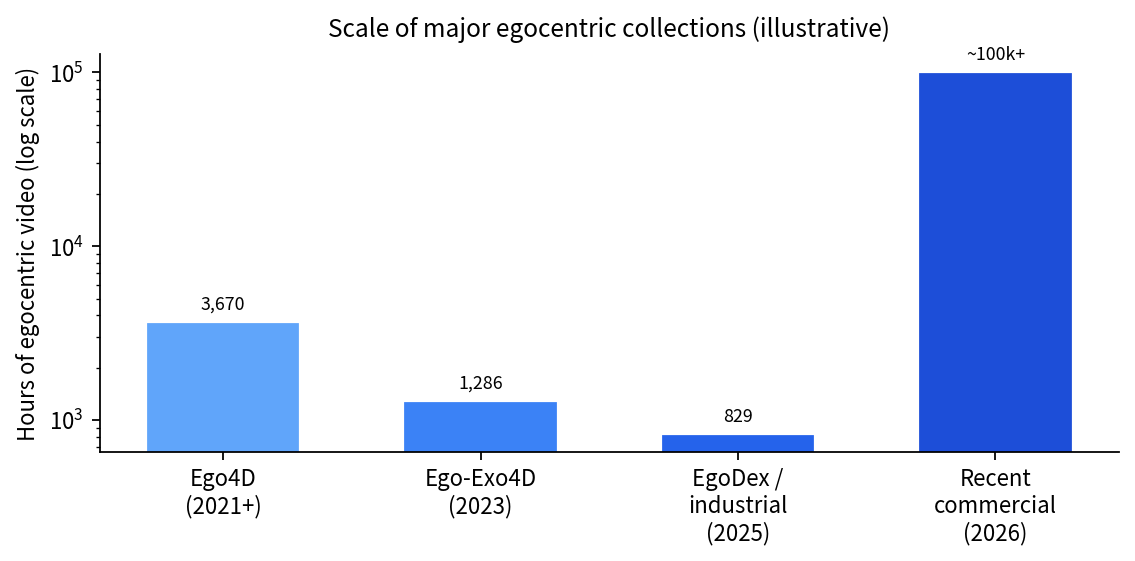
Why Scale Is Not Enough
Most public discussion still measures datasets by hours or frames. These metrics are easy to report and incomplete. Two corpora of similar duration can differ sharply in usable training signal once downstream requirements are taken into account.
Field patterns are consistent. Models trained on large but lightly contextualized egocentric video often post strong frame-level recognition scores yet drop 20–40 percentage points when evaluated on multi-step enterprise workflows, exception recovery or safety-constrained sequences. Short isolated actions look competitive; long-horizon competence does not. Adding even modest amounts of well-contextualized human demonstration data has been shown to lift policy success rates by more than 20 points relative to lower-signal baselines, with further gains when the data is aligned to the target observation and action spaces.
The same scarcity appears on the evaluation side. As models saturate easier academic suites, discriminative signal concentrates in the hardest items—precisely those that require elite domain judgment to design and grade. Reliable measures of operational competence in real commercial environments remain expensive to build and therefore scarce. This elevates any pipeline that systematically captures the judgment and context evaluators themselves need. Public evaluations of economically valuable multi-step tasks already show frontier models still landing well short of reliable production performance when physical or operational grounding is required.
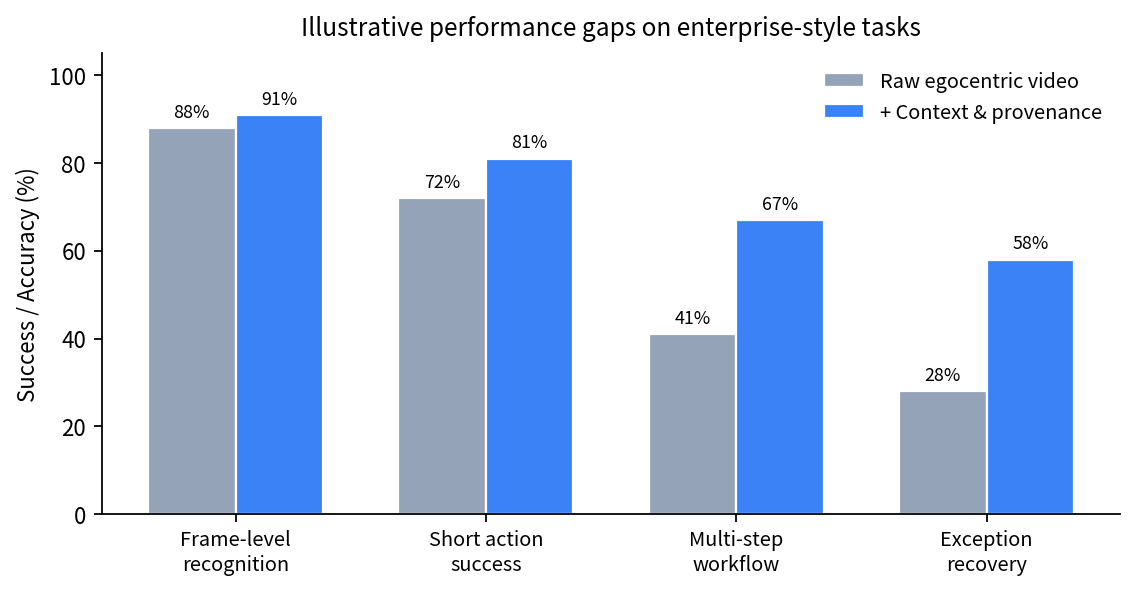
Context, Provenance and Persistent Identity
Three properties turn raw media into usable enterprise assets.
Context is the metadata that situates an observation: skill level of the performer, environmental state, device calibration, task intent, time pressure, safety regime. Two people can produce nearly identical pixel streams while carrying very different informational content. A left-handed expert and a right-handed novice performing the same warehouse pick may look almost the same in the video; the difference in decision heuristics, recovery strategies and timing is precisely the signal a learning system needs if it is to produce reliable rather than average behaviour. Context recorded at capture time is information that cannot be reliably reconstructed later.
Provenance answers the basic questions every enterprise buyer eventually asks: where did this data come from, under what conditions, who collected it, has it been modified, and what rights govern its use. A complete chain—from contributor through device, timestamp, validation and delivery—supports auditability, filtering after the fact, and regulatory documentation. Without it, a dataset is an anonymous bag of frames whose quality and legality cannot be defended under scrutiny. For research prototypes this may be tolerable; for production robotics and regulated enterprise use it is a material risk.
Persistent contributor identity (with consent and governance) enables longitudinal quality tracking, coherent preference signals, detection of individual-level distribution shift, and adaptive matching of validators to both domain and contributor history. Many existing collections treat contributors as one-off observations. Certain applications—skill modeling, continual learning, expert ranking—benefit from continuity. Harbor Passport is one concrete realization of this primitive: it binds consent, longitudinal history and capture integrity to every asset so that enterprise trust travels with the data.
A Provenance-First Architecture
A practical architecture treats these properties as first-class rather than optional post-processing:
- Capture — consented, continuous multimodal streams in real commercial environments (warehouse, trades, logistics, clinical, residential).
- Harbor Passport — persistent identity that binds consent, longitudinal history and capture integrity to every asset.
- Adaptive validation — domain-matched specialists applying operational rubrics rather than generic labeling pools.
- Enterprise delivery — structured manifests, quality scores and full audit trails ready for foundation-model pipelines.
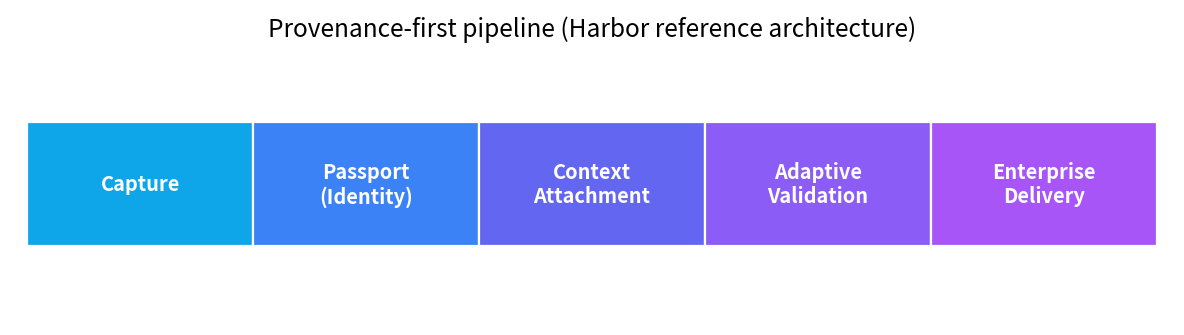
The design choice is deliberate. Context, identity and provenance are not reconstructed weeks later by a labeling pool; they are captured and preserved so that downstream teams can filter, re-weight or exclude assets without reverse-engineering the collection process. In practice this also reduces the number of separate vendors an enterprise team must manage and produces cleaner evaluation manifests for held-out testing.
Counterarguments and Domain Dependence
Synthetic data and high-fidelity simulation have improved geometric and kinematic coverage, yet still struggle with the long tail of real material interactions, lighting extremes, tool wear and skilled human recovery strategies. Hybrid pipelines that combine synthetic scale with real, provenance-rich anchors continue to outperform pure synthetic regimes on most transfer benchmarks.
Reinforcement learning can refine behaviour and reduce the volume of explicit labels required, but still depends on high-quality initial demonstrations or preference data—especially in sparse-reward physical domains. Preference data itself is more coherent when grounded in persistent expert identity over time.
Context is not universally useful; in some pure language or static-image settings it can introduce noise. In egocentric, long-horizon and operational settings its value is typically higher and more consistent. The correct posture is empirical: instrument the pipeline so the contribution of each class of context can be measured against the metrics that matter.
Implementation cost is likewise domain-dependent. For low-stakes research collections the overhead may be hard to amortize. For enterprise, regulated or production robotics pipelines the cost of missing provenance—retraining after contamination, legal exposure, loss of buyer confidence—is frequently higher than the cost of building the chain correctly from the start.
Implications for Teams Buying or Evaluating Data
Volume targets should be paired with explicit requirements for context fields, provenance completeness and identity governance. Held-out evaluation sets should stress long-horizon recovery, skill differentiation and operational exception handling rather than only short-horizon recognition accuracy. Vendor comparisons should include the ability to audit and filter delivered assets after the fact; a lower unit cost that cannot be audited often proves more expensive once quality or rights issues surface.
In environments where models must act in the physical world, the difference between a large, lightly instrumented corpus and a somewhat smaller but fully contextualized, fully provenance-tracked corpus is frequently the difference between a model that looks strong on paper and a model that is reliable in deployment.
Conclusion
If certain categories of model capability continue to become more widely available, durable advantage will migrate toward the infrastructure that supplies high-quality, verifiable, context-aware representations of the real world. Persistent contributor identity, rich contextual metadata and verifiable provenance are architectural primitives, not optional annotations. Organizations that treat them as first-class infrastructure will be better positioned to convert real human experience into reliable model behaviour.
Harbor’s contribution is one practical realization of that principle: an operational system for capturing, validating and delivering egocentric enterprise intelligence while preserving the full chain of context, identity and provenance that modern training regimes increasingly require.
References
[1] Grauman et al. Ego4D: Around the World in 3,600 Hours of Egocentric Video. CVPR / TPAMI extended, 2022–2025. https://arxiv.org/abs/2110.07058
[2] Grauman et al. Ego-Exo4D: Understanding Skilled Human Activity from First- and Third-Person Perspectives. 2023–2024. https://arxiv.org/abs/2311.18259
[3] Build AI and related industrial egocentric releases (Egocentric-10K / 100K / 1M-scale factory collections). 2025–2026. https://www.build.ai
[4] Human-to-robot transfer studies showing substantial gains from high-quality egocentric demonstrations (various 2024–2026). https://arxiv.org/abs/2407.08621
[5] micro1 Research. No Last Mile: A Theory of the Human Data Market; The Benchmark Ceiling. 2026. https://www.micro1.ai/research
[6] Data Provenance Initiative and related audits of training-data lineage, licensing and documentation gaps. 2024–2026. https://www.dataprovenance.org
[7] Harbor technical documentation and operational metrics (contributor network, Passport, adaptive validation, enterprise delivery). 2025–2026. https://harborml.com
[8] Surveys of egocentric datasets for physical AI and robotics (EgoDex, EgoVerse, MobileEgo, HOT3D, EPIC-KITCHENS lineage). 2024–2026. https://epic-kitchens.github.io
[9] Industry reports on sim-to-real gaps and the continuing value of real demonstration data alongside synthetic scale. 2025–2026. https://arxiv.org/abs/2310.08864